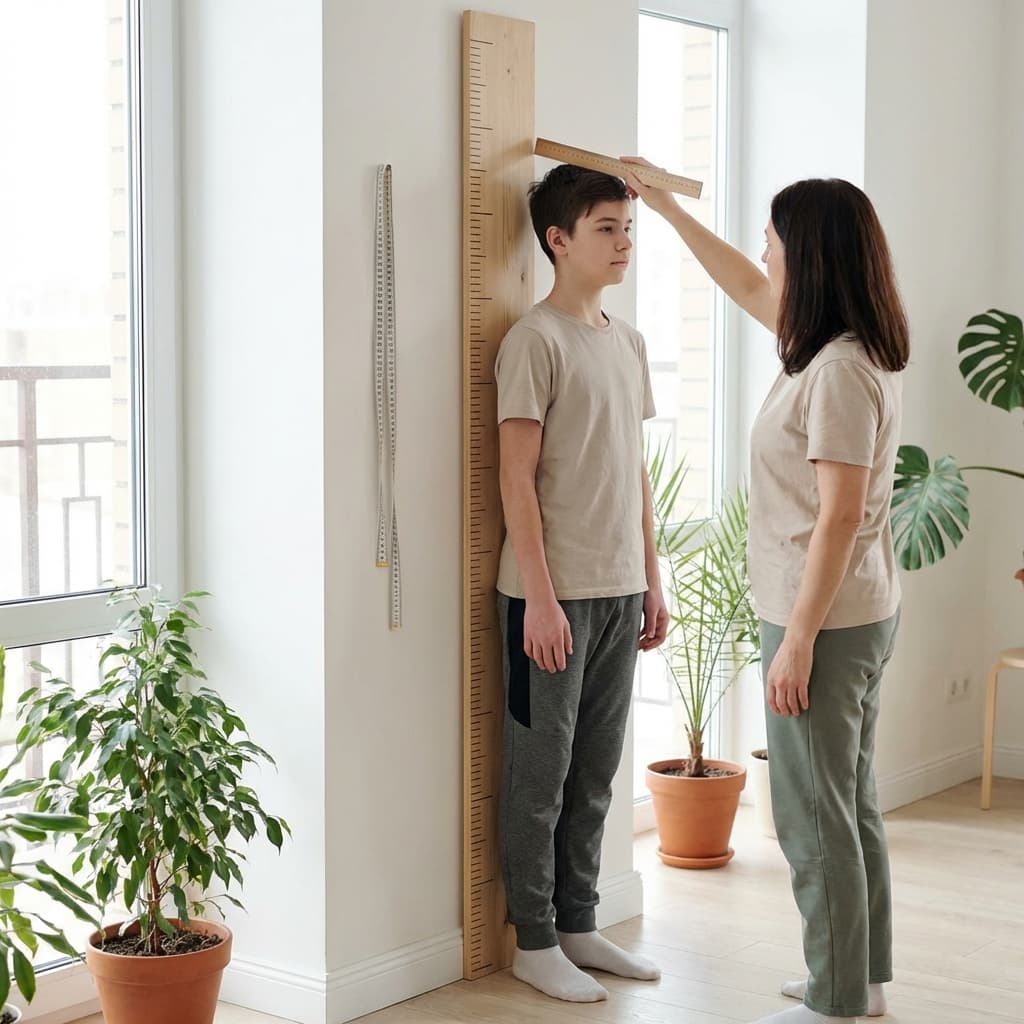
If you're serious about tracking your height growth, accurate measurement is essential. Many teens measure themselves incorrectly and get frustrated by inconsistent results. This guide will teach you exactly how to measure your height properly.
Why Accurate Height Measurement Matters
The Problem with Inaccurate Measuring
- Creates frustration and false hope or disappointment
- Makes it impossible to track real progress
- Can vary by 1 - 2 inches based on technique
- Leads to obsessive re - measuring
Benefits of Proper Technique
- Reliable progress tracking
- Reduces measurement anxiety
- Identifies real growth patterns
- Provides data you can trust
The Science of Height Variation
Before we dive into technique, understand that your height naturally varies throughout the day:
Morning vs.Evening Height
Morning(tallest):
- You're approximately 0.5-1 inch taller
- Spinal discs are fully hydrated from lying down
- Vertebrae are decompressed
Evening(shortest):
- You're approximately 0.5-1 inch shorter
- Gravity has compressed your spine all day
- Spinal discs have lost water content
Key insight: This is why you should ALWAYS measure at the same time of day for accurate tracking.
Factors That Affect Daily Height
1. Time of day - As discussed above
2. Physical activity - Exercise can temporarily compress or decompress spine
3. Posture throughout the day - Slouching creates more compression
4. Hydration - Dehydrated discs compress more
5. Sleep quality - Poor sleep = less spinal recovery
Equipment You'll Need
Essential Items
- Flat wall without baseboard (or measure from above baseboard)
- Hard, flat floor (not carpet)
- Measuring tape or ruler (metric is more precise)
- Flat object to place on head (book, ruler, or flat box)
- Pencil for marking(optional)
- Mirror to check posture(helpful)
Helpful Additions
- Height stadiometer(the device doctors use) - available for home purchase($20 - 50)
- Wall - mounted growth chart
- Digital measuring device
The Correct Measurement Technique
Step - by - Step Process
1. Choose Your Time
- Pick morning(within 30 minutes of waking) OR evening(before bed)
- Stick to the SAME time every time you measure
- Morning measurements will be your "maximum" height
2. Prepare the Space
- Find a wall that meets the floor at a right angle
- Remove shoes and socks
- Stand on hard floor(no carpet or rugs)
- Ensure area is well - lit
3. Position Your Body
Stand with:
- Heels together, touching the wall
- Buttocks touching the wall
- Shoulder blades touching the wall
- Back of head touching the wall(if possible naturally)
4. Check Your Posture
Important posture points:
- Stand straight, don't stretch or strain upward
- Keep chin level(not tilted up or down)
- Look straight ahead at a point on wall across the room
- Shoulders relaxed, not hunched or lifted
- Arms hanging naturally at sides
5. The Frankfurt Plane
Your head should be positioned in the "Frankfurt Plane":
- The lower edge of your eye socket(orbital)
- Should align horizontally with your ear canal(tragion)
- In simple terms: chin not tilted up or down
6. Take the Measurement
Using a flat object on your head:
1. Have someone place a flat object(book, ruler) on top of your head
2. The object should be parallel to the floor
3. It should press gently but firmly against your hair
4. Mark where the bottom of the object meets the wall
5. Step away and measure from floor to mark
Self - measurement:
1. Position yourself correctly against wall
2. Place flat object on head, slide it back to touch wall
3. Mark wall or hold object in place
4. Step away and measure
7. Record the Measurement
Write down:
- Date and time
- Height measurement(be precise)
- Any notes(morning vs.evening, recent activities)
Common Measurement Mistakes
Mistake 1: Measuring at Different Times
Problem: Comparing morning and evening heights
Solution: Always measure at the same time
Mistake 2: Stretching Upward
Problem: Artificially adding height that isn't real
Solution: Stand naturally tall, don't strain
Mistake 3: Tilting Head Up
Problem: Can add 0.5 + inches falsely
Solution: Keep chin level, use Frankfurt Plane
Mistake 4: Measuring on Carpet
Problem: Carpet compresses, reducing accuracy
Solution: Always use hard floor
Mistake 5: Not Having Heels Against Wall
Problem: Body angle affects measurement
Solution: Ensure heels, buttocks, and shoulders touch wall
Mistake 6: Using Incorrect Surface on Head
Problem: Hair compression varies
Solution: Use flat, rigid object pressed firmly
Mistake 7: Measuring Too Frequently
Problem: Height changes slowly; daily measuring creates anxiety
Solution: Measure weekly or monthly maximum
How Often Should You Measure ?
Recommended Frequency
During growth spurts(rapid growth periods):
- Weekly measurements are reasonable
- Same time, same conditions
- Document any changes
Normal periods:
- Monthly measurements are sufficient
- Reduces obsessive behavior
- Shows meaningful trends
Never:
- Multiple times per day
- After intense exercise
- When anxious or stressed about results
Tracking Your Growth
Create a simple log:
| Date | Time | Height | Notes |
|---|---|---|---|
| Jan 1 | 7: 30 AM | 5'7.5" | Morning, rested |
| Feb 1 | 7: 30 AM | 5'7.75" | Morning, rested |
| Mar 1 | 7: 30 AM | 5'8" | Morning, rested |
Understanding Your Growth Rate
Normal Growth Rates by Age
Ages 10 - 12:
- Girls: 2 - 3 inches per year
- Boys: 2 - 2.5 inches per year
Ages 12 - 14:
- Girls: 2 - 3 inches per year(may slow)
- Boys: 2.5 - 3.5 inches per year(accelerating)
Ages 14 - 16:
- Girls: 0.5 - 2 inches per year(slowing)
- Boys: 2 - 4 inches per year(peak growth)
Ages 16 - 18:
- Girls: 0 - 0.5 inches per year(near final height)
- Boys: 1 - 2 inches per year(slowing)
Red Flags to Discuss with Doctor
- No growth for 6 + months during puberty
- Growth rate well below normal range
- Sudden deceleration in growth
- Growing more than 4 inches in 6 months
When Doctor Measurements Differ
Don't panic if your doctor's measurement is different from yours:
Reasons for Discrepancy
1. Different time of day - Doctor visits often happen mid - day
2. Different equipment - Medical stadiometers are more precise
3. Stress - You might stand differently at doctor's office
4. Technique - Healthcare providers are trained in measurement
What to Do
- Use doctor's measurements for medical comparisons
- Use your home measurements for personal tracking
- Be consistent with your own method
- Don't combine different measurement sources
Height Tracking Apps and Tools
Digital Options
- TallerTeen app(track measurements and get growth insights)
- Growth chart apps
- Simple spreadsheet
- Health apps with growth tracking
Physical Tools
- Wall - mounted growth chart(fun visual!)
- Stadiometer for home use
- Height measuring tape attached to wall
The Psychology of Height Measuring
Healthy Mindset
- Use measurements as information, not judgment
- Celebrate progress, but don't obsess
- Understand height is just one aspect of who you are
- Focus on things you can control(sleep, nutrition, exercise)
Warning Signs of Unhealthy Focus
- Measuring multiple times daily
- Mood depends on measurement results
- Comparing obsessively to others
- Extreme distress over normal numbers
Building Confidence
- Track other progress(exercise, nutrition, sleep)
- Celebrate healthy habits, not just height
- Remember that height doesn't define worth
- Focus on becoming the best version of yourself
Conclusion
Accurate height measurement is a useful tool for tracking your growth, but it's just one piece of the puzzle. By using proper technique and measuring consistently, you'll get reliable data without the frustration of inconsistent results.
Key takeaways:
1. Always measure at the same time of day
2. Use proper posture and technique
3. Measure monthly, not daily
4. Track trends, not single measurements
5. Don't let height define your self-worth
Want to track your height growth along with sleep, nutrition, and exercise ? Download TallerTeen for comprehensive growth tracking, personalized insights, and science - backed tips for maximizing your height potential.