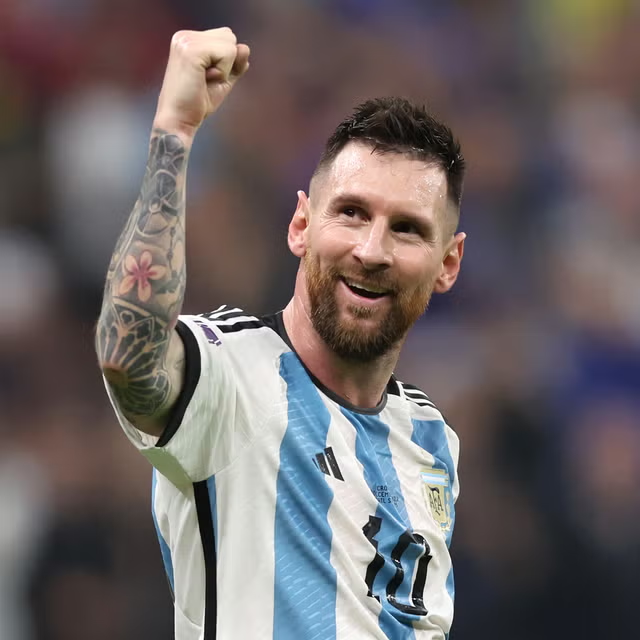
Lionel Messi
World Cup Winner • 8× Ballon d'Or
Before
Diagnosed at age 11
11 years old
Final Height
5'7"
Lionel Messi is often called the greatest footballer of all time. Yet as a child, he faced a significant medical challenge that threatened to end his dreams before they began. His story is one of overcoming physical limitations and proving that greatness comes in all sizes.
A Boy from Rosario
Born in Rosario, Argentina in 1987, Lionel Andrés Messi grew up in a working-class family. His father, Jorge, worked in a steel factory. His mother, Celia, worked in a magnet manufacturing workshop.
From the moment he could walk, Leo (as his family called him) had a football at his feet. He played in the streets of Rosario with his older brothers and cousins. His grandmother, Celia, was his biggest fan, taking him to practices and cheering from the sidelines.
But even as a young child, it was clear something was different about Leo. He was smaller than other kids his age. Much smaller.
At age 8, he joined the youth academy of Newell's Old Boys, a local club. His talent was undeniable — he dribbled past defenders twice his size with ease. But his size became increasingly concerning.
The Diagnosis
At age 11, doctors delivered devastating news: Lionel Messi had growth hormone deficiency (GHD), a condition where the pituitary gland doesn't produce enough growth hormone. Without treatment, he would remain significantly shorter than average.
The treatment existed — daily growth hormone injections — but it was expensive. Very expensive. Around $1,000 per month, which was far beyond what the Messi family could afford on their factory wages.
"We couldn't pay for it," Jorge Messi recalled. "We tried everything. We asked the local club for help. We asked our insurance. Nothing worked."
Meanwhile, Leo continued playing football, but the physical gap between him and other players was growing. Some opponents would mock him on the field. "Look at the little kid," they'd laugh. "Go home to your mama."
Leo would cry after games, not from the teasing, but from the fear that his dream was slipping away. His grandmother Celia would comfort him: "You're special, Leo. Don't ever forget that."
Barcelona's Gamble
In 2000, when Leo was 13, his family arranged a trial with FC Barcelona in Spain. The club's youth coach, Carles Rexach, watched this tiny Argentine boy play for just 10 minutes.
He immediately knew he was watching something special.
Rexach was so convinced of Messi's talent that he offered him a contract on the spot — famously written on a napkin because no official paper was available. But the offer came with a crucial promise: Barcelona would pay for Leo's growth hormone treatment.
The Messi family made the difficult decision to move to Spain, leaving behind their entire life in Argentina. Leo was 13 years old, moving to a new country, speaking a different language, and facing daily injections to help him grow.
The treatment was painful. Every night, Leo had to inject growth hormone into his legs. The needles hurt. Sometimes he'd cry. But he never complained. He knew this was his only chance.
"I just wanted to play football," Messi said years later. "If injections were what it took, I'd do it."
From Small Boy to Giant of the Game
The treatment worked. Slowly but surely, Leo grew. He reached 5'7" — still shorter than most professional footballers, but tall enough. More importantly, his skill continued to develop at an extraordinary rate.
At 17, he made his first-team debut for Barcelona. At 19, he scored his first goal. By 21, he was already being called the best player in the world.
What followed was a career that redefined football:
- 8 Ballon d'Or awards (most ever) - 4 Champions League titles with Barcelona - 2022 World Cup winner with Argentina - Over 800 career goals - Countless records broken
But Messi never forgot where he came from. He never forgot the injections, the doubt, the fear that his body wouldn't let him achieve his dreams.
"I'm grateful for everything," Messi said. "The difficult times made me appreciate the good times even more."
The Lesson
Lionel Messi's story is proof that physical challenges don't have to limit what you can achieve. He faced a real medical condition that could have ended his career before it started. He was mocked for being small. He had to endure painful treatments just to have a chance.
But he never gave up.
Today, at 5'7", Messi is considered by many to be the greatest footballer who ever lived. He's won more individual awards than anyone in history. He's inspired millions of kids around the world who were told they were "too small" to make it.
"I learned that size doesn't matter," Messi said. "What matters is your heart, your dedication, and your love for what you do."
For teenagers facing physical challenges, medical conditions, or doubts about their bodies: Messi's story shows that greatness isn't measured in inches. It's measured in determination, skill, and the courage to keep going when everyone says you can't.
Your height doesn't determine your worth. Your dreams don't have a minimum height requirement. And sometimes, the smallest players leave the biggest legacy.
"I learned that size doesn't matter. What matters is your heart, your dedication, and your love for what you do."
— Lionel Messi
Timeline
Birth
Born in Rosario, Argentina
8
Joined Newell's Old Boys youth academy
11
Diagnosed with growth hormone deficiency
13
Moved to Barcelona; club agreed to pay for treatment
13-17
Daily growth hormone injections, grew to 5'7"
17
First-team debut for Barcelona
19
First goal for Barcelona
Career
8× Ballon d'Or, World Cup winner, 800+ goals
Sources:
Growth depends on genetics, age, and puberty timing. This story is for inspiration only.
Ready to Start Your Journey?
Build healthy habits that support your wellness during your growing years.
Download TallerTeen